

FAQs
want to know more? see below!
What is covered in 10.521?
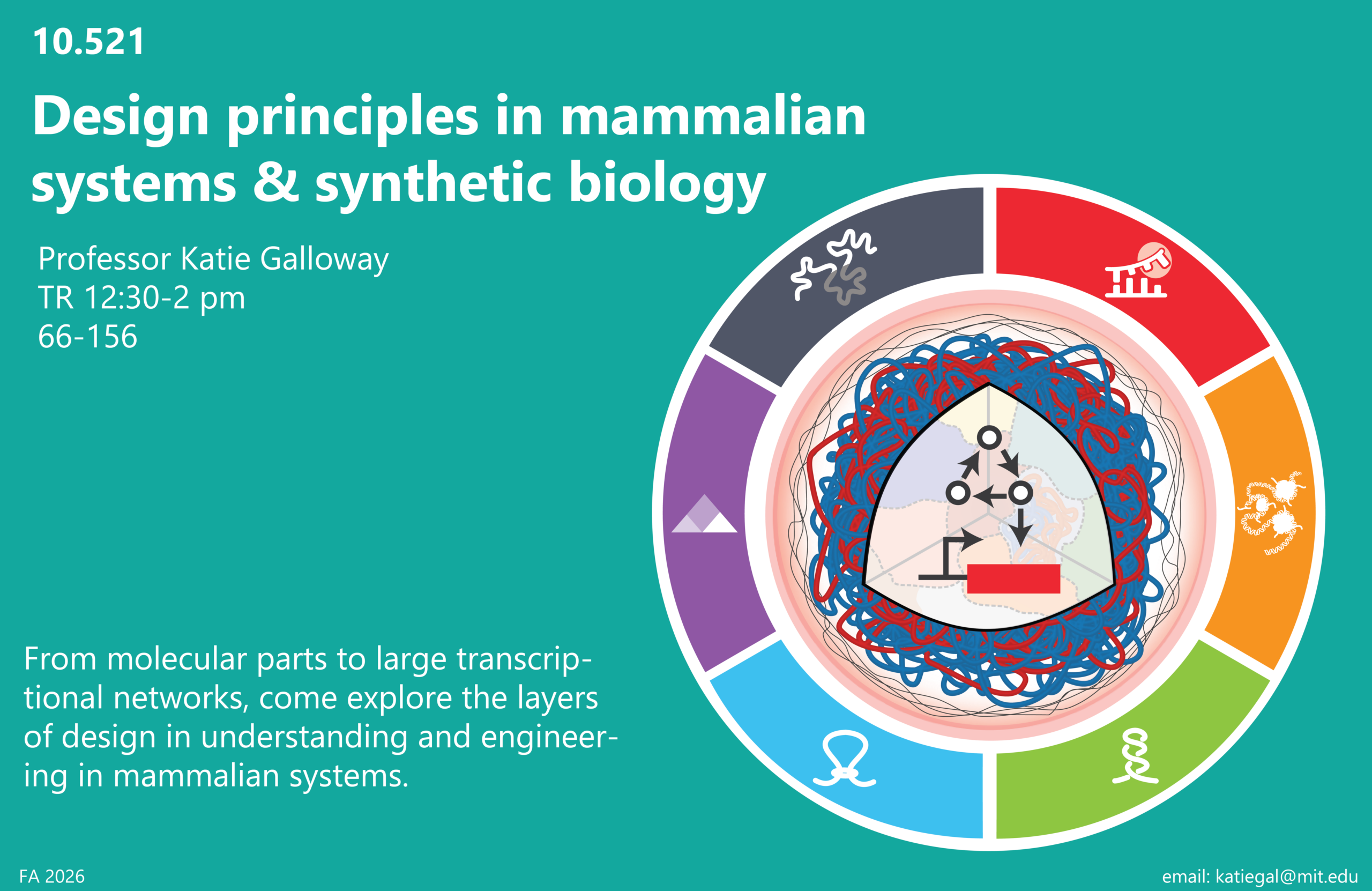
This course focuses on the layers of design, from molecular parts to large
transcriptional networks in mammalian biology. The course formally introduces
concepts in the emerging fields of mammalian systems and synthetic biology,
including engineering principles in the design of dynamic systems, molecular
design of genetic parts, and integration into the genome.
Who should take this course?
This course is primarily designed for graduate students and advanced
undergraduates looking to dive into topics in mammalian synthetic and systems
biology.
How is the course structured?
The class is broken into several modules beginning with intro to synthetic
biology, design principles in systems biology, and unique challenges in
mammalian systems. On Tuesdays, we will have a lecture introduce the week’s
topic and on Thursdays we will have our reviewed the literature through a
“speed journal club” based on five selected papers and five-student paired
papers. In the speed journal club format, students have five minutes and one
slide to summarize the paper, finding, and relevance. Over the course of the
class, we cover ~80 papers.
Can I see the syllabus?
Sure, here it is for
2024,
2022,
and
2021.
But keep in mind that each year the class changes a bit as the material is
updating and structured assignments and group projects are adapted to the
cohort of students that enroll.
What if I don’t have a background in mathematical modeling?
We have a primer to get you going from mass action kinetics to Hill Functions,
etc. This will require some extra time as the modeling project is a central
part of the course. Students have done very simple to very sophisticated
modeling which has been included in published journal articles and theses.
Do I need a background in biology to do well in this class?
No, but that does help. As long as you are willing to learn basic molecular
biology and have a solid foundation in kinetics, thermodynamics, and
differential equations, you successfully engage with the material.